

MUSIC SCORES & ORIGINAL COMPOSITIONS
Intergenerational music performing and learning of Black history.

The collection of musical scores in the HUB includes compositions by African American composers and arrangements of African-inspired melodies. Castle of our Skins' collection of work feature age-appropriate, companion curriculum with scaffolded lesson plans are rooted in Afrocentric pedagogical practices that emphasize experiential learning, group participation, aural skills, and individual creativity. With their buildable lesson units and relevance to other subjects, they provide a deeper context (and in some school systems, the only context) for music, Black history, social justice, and culture to be appreciated.
Standards Alignment: National Core Arts Standards (Performing/Presenting/Producing)
-
MU:Pr4.1.E.8a — Select, analyze, and interpret artistic work for presentation
-
MU.Pr5.1.E.5a, MU.Pr5.1.E.8a, or MU.Pr5.1.E.Ia — Develop and refine artistic technique and work for presentation
-
MU.Pr6.1.E.8a, MU.Pr6.1.E.Ia, or MU:Pr6.1.E.IIa — Convey meaning through the presentation of artist work

Learn more about our
scores + curriculums below!


Catto’s Courage for string quartet & intermediate string ensemble
Catto’s Courage depicts the strength of Octavius Catto, a dedicated civil rights leader and desegregationist in post-Civil War Philadelphia. Catto was murdered on Election Day in 1871, one year after African Americans were constitutionally granted the right to vote with the ratification of the 15th Amendment. Through music and companion curriculum guides, students will intimately engage with his life and legacy.
Listen to a live performance with Castle of our Skins and Boston's Project STEP, a renowned string training education program that provides talented young musicians that identify with historically underrepresented groups in classical music with comprehensive music instruction.
Performed live, March 12, 2023 at the Shalin Liu Performance Center in Rockport, MA.
Chorale for Phillis, Harriet and Mum Bett for string quartet & beginner string ensemble
Chorale for Phillis, Harriet and Mum Bett introduces three legendary Black historic figures to young learners: poet Phillis Wheatley, abolitionist and author Harriet A. Jacobs, and the formerly enslaved Mum Bett who became the first African American woman to successfully file a lawsuit for her freedom in Massachusetts. As all of their lives intersected with the institution of slavery, students will learn of history, racialized enslavement, strength, and resilience.


Listen to a live performance with Castle of our Skins and Boston's Project STEP, a renowned string training education program that provides talented young musicians that identify with historically underrepresented groups in classical music with comprehensive music instruction.
Performed live, March 12, 2023 at the Shalin Liu Performance Center in Rockport, MA.


A Little History for solo narrating Violin, Viola, or Cello
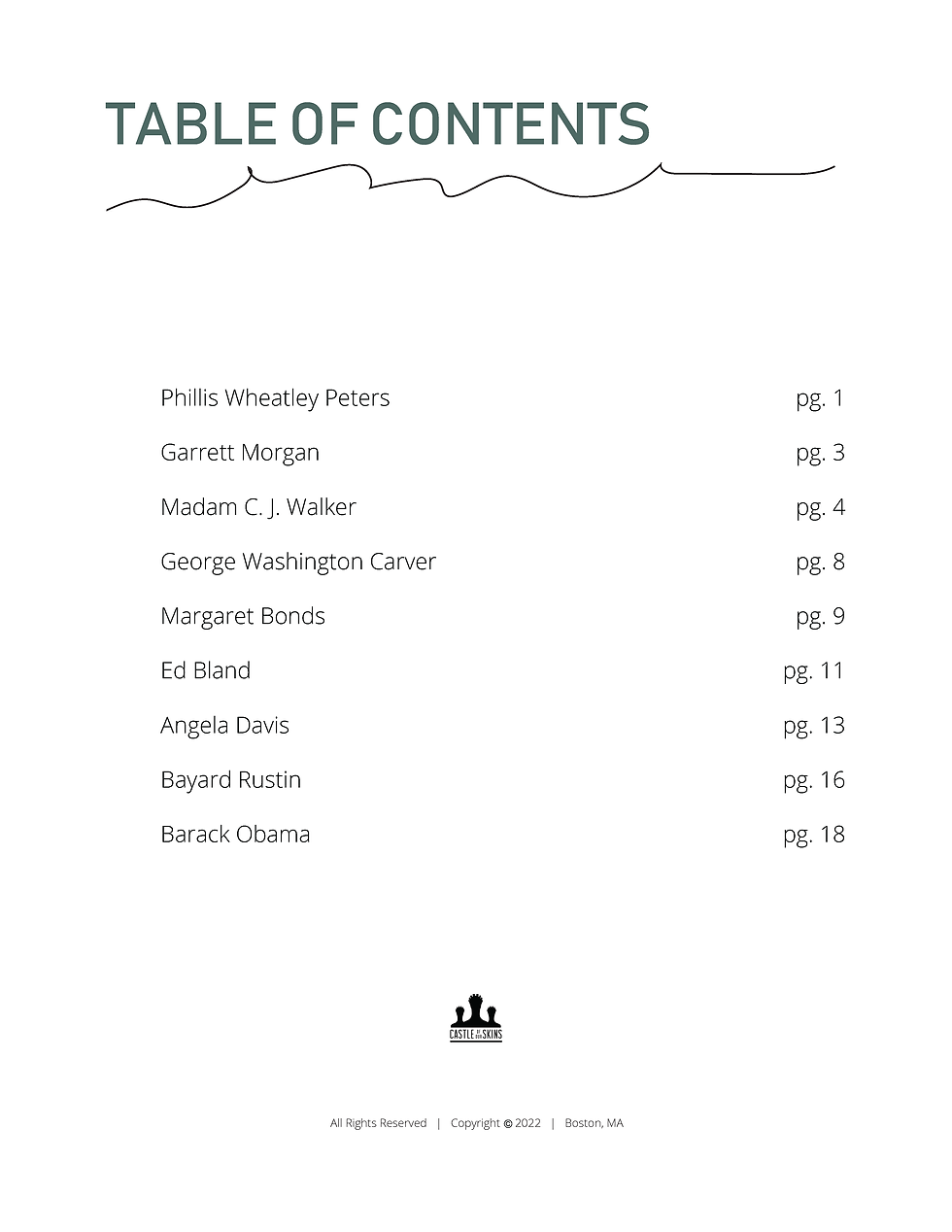
A Little History tells the simplified stories of nine legendary figures in Black History through original music, poetry and interaction. This edition, designed for students in grades 2-6, includes a variety of engagement materials including a performance score, curriculum guide with buildable units and worksheets, beautiful portrait cards of all nine figures, and a PowerPoint presentation. The figures represented include poet Phillis Wheatley Peters; inventors/entrepreneurs Garrett Morgan and Madam C. J. Walker; agriculturist George Washington Carver; composers Margaret Bonds and Ed Bland; and activists/political figures Angela Davis, Bayard Rustin, and Barack Obama.
Listen to a short excerpt of Castle of our Skins' Artistic Director and Co-Founder, Ashleigh Gordon, perform A Little History for solo viola. This specific excerpt tells the story of Phillis Wheatley Peters, the first historical figure featured in the series.
Performed for students of the British International School of Boston (Boston, MA) in February 2025.
Compadre Pedro Juan for String Quartet & Beginner String Ensemble
Originally composed by Luis Alberti, a celebrated Dominican musician known for his contributions to merengue and folk music, this piece invites students to experience the joyful energy of Compadre Pedro Juan, a lively tune encouraging dance and connection. The guide features engaging, buildable lesson units designed to make learning merengue accessible and fun for students of all skill levels.


Choucoune for String Quartet & Beginner String Ensemble
This newly arranged version by composer Anthony R. Green beautifully captures the essence of Oswald Durand's original Haitian poem about unrequited love. Designed for string quartet and beginner ensembles, this arrangement brings a slower, heartfelt rendition of the beloved tune. Through the included curriculum guide, students will discover the story, environment, and musical techniques that define this iconic piece.
A Little History 2.0 for solo narrating Marimba, Vibraphone, or Gyil
The second edition of A Little History tells the simplified stories of nine historical moments in Black History through original music, poetry and interaction. This new edition, designed for students in grades 2-6, includes a variety of engagement materials including a performance score, curriculum guide with buildable units and worksheets, portrait cards of all nine moments, and a PowerPoint presentation. The moments represented include Benin City, Africans in the America (Mansa Abubakari II), Igo Landing, Seneca Village, the First Black Deliverywoman (Mary Fields), Airship before Airplane (Charles F. Page), When Black People Tell our Stories (Tulsa Race Massacre) A Math Genius (Katherine Johnson), and Celebrating Juneteenth.


Listen to a short excerpt of Castle of our Skins' Teaching Artist, Steph Davis, perform A Little History 2.0 for solo marimba. This specific excerpt tells the story of Africans in the Americas, one of the historical moments featured in the series.
Performed at the Museum of Fine Arts in Boston, MA on Juneteenth (June 2025).

The Call to the Feast - Score Title
The Call to the Feast - Score Title
The Call to the Feast for Mixed Chamber Ensemble
"The Call to the Feast," arranged by Danielle Williams, is a movement excerpted from three African Dances by Amanda Aldridge (writing under the pseudonym Montague ring). Originally written as a piano suite for amateur musicians, this arrangement was created for chamber ensemble, consisting of flute, oboe, violin, viola, cello, and piano. The work blends West African-inspired melodies with folk harmonies and rhythms. Its aim is to bring Aldridge's rarely performed music to new generations of young performers, while celebrating her legacy as a pioneering Black British composer who bridged classical traditions and African musical heritage.
Peace Like a River for String Quartet & Beginner String Ensemble
Peace Like a River is a beloved historical spiritual and hymn that reflects a deep, resilient sense of inner peace. In this imaginative arrangement, composer Anthony R. Green brings the song to life by having the string ensemble speak the lyrics and musically paint the images of flowing water — from a gentle river to a fountain and the vast ocean.
The accompanying Curriculum Guide offers ready-to-use lesson plans designed to strengthen string techniques and storytelling through music. Educators will find adaptable activities and listening exercises that deepen ensemble skills while connecting students to the song’s historical and emotional context.


Yonder Come Day for String Quartet & Beginner String Ensemble
Yonder Come Day is a traditional African American spiritual from the Georgia Sea Islands. Composer Anthony R. Green created his own arrangement that adds a surprise element, with a faster and funkier version than the original. Written for string ensemble, students will add the joy of funk to match the main lyrics of the song through playing, stomping, and percussive techniques!
The accompanying curriculum guide includes ready-made lesson plans that support the learning of the musical elements of Funk, Spirituals, Work Songs, and Game Songs, all of which play a role in this arrangement of Yonder Come Day. Additional activities build onto the key concepts of the piece through listening, along with telling the history of the Gullah/Geechee Nation that inhabits the Georgia Sea Islands.
Reflections of the Unseen for String Ensemble
Drawing inspiration from modernism, impressionism, jazz, and the African rhythmic pattern known as the tresillo, composer Maxwell Fairman weaves melodic and percussive motives into a dynamic musical narrative for Reflections of the Unseen. Through vivid musical storytelling, the piece follows the journey of a man attending a Friday night party, where a chance encounter and the thrill of the moment carry him through an unforgettable evening.
The accompanying Curriculum Guide helps students explore the piece through the lens of storytelling and film scoring. Ready-made lesson plans invite learners to bring the narrative to life using techniques inspired by professional film-scoring sessions, while additional activities break down key musical concepts through listening, discussion, and performance-based learning.


as I recall for String Ensemble
Written for mixed string ensemble (2 violin, cello, and bass), composer Yaz Lancaster pulls directly from Negro Spirituals by incorporating student-composed fragments of several songs into "as I recall".
The piece samples those fragments, adding in elements of Black American music, such as guided improvisation and call-and-response. This final version puts forward a musical response for memory preservation and the importance of written and aural documentation, in retelling histories of oppressed peoples.


Glimmering Labyrinth for String Quartet & Harp
Inspired by the mystical imagery of a labyrinth filled with glowing gemstones, Glimmering Labyrinth by composer Lilyanne Leccima draws on influences from Black diasporic music, contemporary progressive rock, and the Phrygian mode to create a captivating musical landscape. Leccima describes the work as evoking "the ethereal light of luminescent gemstones peering through cracks in the walls," inviting performers and audiences alike to explore a rich and vibrant sonic world.
The accompanying Curriculum Guide offers ready-to-use lesson plans that help students engage deeply with the piece through improvisation, creative exploration, and performance practice. Students are introduced to the extended techniques featured in the work while building their understanding of key musical concepts, including the Phrygian mode, melodic and harmonic voicing, and the influence of Black diasporic musical traditions.

as i recall Cover

as i recall About the Creators

as i recall Score pg. 1
as i recall Cover